miércoles, 26 de octubre de 2016

Thinking skills: James Bulger case

By analyzing the whole case of James Bulger's murder, our reasoned judgement is as follows:
Corroborative and conflicting evidence:
- One of the boy's stepfather owned a collection of violent videos.
- The boys would watch violent videos as they skipped school.
- The stepfather of one of the boys had rented "Child's Play 3", a violent film, one week before the incident.
- There were significant similarities between scenes in the film and the killing of Hames Bulger.
- One of the children had parental issues: a drunken mother and suicide tendencies. The other one had behavior issues. Both children lived in poverty and had divorced parents.
Balance of evidence:
The press campaign suggests that the boys' actions may have been influenced by video nastiest. This is also supports this point of view. On the other hand, the police states that  statistics fail to prove a reliable measure of crime; there's no way to really prove te children have watched the nasties.
While it is true that video nasties can affect children's attitudes towards the actions they take, we believe that the biggest cause of their behavior is due to the family background they grew up in

jueves, 13 de octubre de 2016

Clonación terapeutica con celulas madre

La paraclonación
FotorCreated.jpg
La clonación a la que haré referencia en este texto es a la del tipo terapéutica, aquella que tiene como objetivo tratar enfermedades sin toparse con riesgos inmunológicos.  La paraclonación es un método por medio del cual se le extrae el núcleo a la célula de un ser vivo adulto. El mismo es implantado en un óvulo carente de su propio  núcleo.  El embrión producido como resultado se desarrolla en un laboratorio hasta alcanzar el estado blastocisto, es decir, cuando se compone de más de un centenar de células. A partir de ellos, es colocado en el útero elegido para tal fin.  
Entonces, la clonación terapéutica se reduce a la etapa celular del embrión, y el objetivo primordial es la elaboración de células madre. Éstas son capaces de reproducirse ilimitadamente y son empleadas para tratar gran cantidad enfermedades. A partir de ellas se tratan condiciones como problemas hematológicos y del sistema inmune y para trasplantes de células de médula ósea. Se transfieren células progenitoras hematopoyéticas mediante trasplantes de células madre sanguíneas.  Además, enfermedades malignas como leucemias o tumores y no malignas como diabetes o anemias tambien son tratables. Por lo tanto,  las terapias con células madre son para reemplazar y restaurar células dañadas de pacientes.
La paraclonación es un uso médico controversial, algunos sostienen que estos métodos no son éticos y por lo tanto no deben ser llevados a la práctica. Yo creo que, mientras la clonación no sea reproductiva, es aceptable porque objetiviza un bien común. Muchas vidas pueden ser salvadas y las condiciones de vida y de salud en los pacientes puede ser altamente restaurada y mejorada en cuanto a calidad.

martes, 30 de agosto de 2016

Mash up de actividades: Reflexión sobre la huella ecológica del hombre

Luego de que uno ve el video llamado “Queridas futuras generaciones: Perdón”  genera sus propias conclusiones e inquietudes con respecto al tema que está siendo tratado. En pocas palabras el video narra el impacto de la huella ecológica del hombre. El poder económico y el dominio están por encima de todo en este mundo en el que hoy habitamos, todo está ligado a la competencia y a innovadores métodos o formas que objetivizan la ganancia sin importar los efectos adversos que pueden generar en el medio ambiente.
Lo que el “rap” del video expresa es la cruda realidad, las riquezas más preciadas no son las que antes se encontraban y cuidaban en la naturaleza, hoy para conseguirlas se destruyen ecosistemas para fabricar papeles, simples papeles impresos considerados por el humano, totalmente valorables. Lamentablemente, el afán del hombre por llenarse los bolsillos supera toda escala, y los más débiles, los indefensos son los que salen perdiendo. Miles de especies desaparecen y otros centenares se suman a la lista negra de seres vivos en riesgo de extinción.
Cuando uno termina de ver el video, interpreta el profundo mensaje y el nivel caótico de la situación mundial y evidentemente piensa que es irreversible,  que no vale la pena obrar para bien si es que ya está todo arruinado. Sin embargo, es acá donde el individualismo debería surgir como última alternativa de lucha. Yo creo que a pesar de que son, obviamente, extremas las circunstancias en las que dejamos al planeta, la predisposición se encuentra en cada uno para comenzar a revertir el proceso de “automutilación” que hemos permitido por años en este mundo. Y digo automutilación porque, aunque no muchos se den cuenta o lo ignoren, el hecho de dañar de tal forma al medio ambiente, termina por dañarnos a nosotros mismos y a nuestros futuros descendientes.Resultado de imagen para huella ecologica


miércoles, 17 de agosto de 2016

Peligro de extinción

R i e s g o    d e    e x t i n c i ó n

Una especie se considera en peligro de extinción, sea vegetal o animal, cuando todos los miembros vivos de dicha especie están en peligro de desaparecer. Pero,  ¿qué causas son las que llevan a una especie a encontrarse en semejante riesgo?
Aunque existen causas naturales y fenómenos climáticos que alteran el orden y perjudican a un ecosistema, la mano del hombre es el eje del conflicto. A pesar de que ninguna de las acciones del ser humano que terminan impactando negativamente en el ambiente involucrando a especies inocentes se justifica, la más  debatida e intolerable por gran parte de la población mundial es la caza indiscriminada.
La caza es uno de los más antiguos factores que afectan a las especies alrededor del mundo y tiene diversos fines como por ejemplo:
  • Deporte
  • Fines comerciales (pieles - estuillas de marfil...)
  • Eliminación de grandes depredadores que afectan el ganado
  • Disturbio y persecución: incluyen la erradicación y destrucción de especies silvestres consideradas plaga.

Caso Yaguareté:
Este animal tuvo una amplia dispersión en Argentina la cual sostuvo bien entrado el siglo 20 y hasta la década de 1960 aún se seguía considerando a este especie como una “dañina” en las provincias de Catamarca y Salta. Hoy los yaguaretés son una rareza, extinguidos en casi todas las provincias y sólo protegidos en algunos parques nacionales.

Otra de las causas que conllevan a una especie al borde de la desaparición total es la destrucción de hábitats. La expansión de actividades humanas como la agricultura, la ganadería, construcción de ciudades y rutas entre otros factores, se basan en la alteración de un ecosistema,  interrumpen el medio ambiente de los seres vivos provocando el desplazamiento y la muerte de los mismos. La deforestación con palas mecánicas es muy rápida y significó la drástica eliminación de fauna silvestre en  el oeste de Santiago del Estero, noroeste de Tucumán y el este salteño.
Caso Misiones:
Lo que principalmente era una selva de alrededor 2.600.000 hectáreas, como consecuencia de la deforestación, sufrió una disminución radical.  La espesura desapareció en más de la mitad del suelo provincial, en los últimos 100 años Misiones perdió 1.500.000 hectáreas.

La última de las causas más controversiales y severas en la gran lista de factores que tienen consecuencias en las vidas de seres animales y vegetales es la introducción de nuevas especies a un hábitat determinado. El término “introducción” hace referencia a la depredación o a la competencia de especies exóticas que fueron introducidos en un ecosistema.  Pero ¿Por qué se lleva a cabo este cambio?. Algunas de las razones pueden ser estéticas, económicas y mismo para que estas compitan contra especies nativas.

Dato: En la Pcia. de Buenos Aires el 30% de las especies vegetales son exóticas.

viernes, 1 de julio de 2016

Genética

Genética
¿Que es la “meiosis”?
  • Es el proceso de división celular, propio de las células reproductoras, en el que se reduce a la mitad el número de cromosomas.

¿En que se relacionan la meiosis con las mutaciones cromosómicas?
Las mutaciones cromosómicas o cromosomopatías son alteraciones en el número de genes o en el orden de estos dentro de los cromosomas y se deben a errores durante la gametogénesis (formación de los gametos por meiosis) o de las primeras divisiones del cigoto.

Las aberraciones numéricas o anomalías de los cromosomas producen cerca del 6% de las malformaciones que se observan en infantes nacidos vivos. Las anomalías cromosómicas sexuales implican la pérdida o la ganancia de un cromosoma sexual generando individuos aneuploides.

Dentro de las aneuploidías sexuales podemos distinguir  a las siguientes:
  1. Trisomías sexuales
Las trisomías son aquellas donde se evidencia un cromosoma sexual extra
  • Síndrome de Klinefelter, XXY
  • Síndrome del triple X, XXX (Llamado síndrome del super hembra)
  • Síndrome del doble Y, XYY (Llamado síndrome del superhombre)


2. Monosomías sexuales: Las células que han perdido un cromosoma sexual
  • Síndrome de Turner, XO
3.   Polisomías sexuales:
  • XXXY
  • XXXX


domingo, 26 de junio de 2016

The Wall

The Wall: Activities
Julieta Veo


1: 1. The boy sees masks on the faces of the people in the train. Later he sees similar masks on the faces of the children in his fantasy. What is the meaning of that?
The scene where the people in the train got masks on their faces is linked with a historical event, when the Jews were taken to concentration camps during Hitler’s dictatorship. Afterwards, the boy sees masks on the faces of the children in his fantasy who are dragged towards a painful end which represents the lack of personal thoughts due to the possessive educational system. In both cases, the masks represents the repression of individuality. The faceless persons portray a dramatic scene, they don’t look human and this is caused due to the systems and its laws. The lack of expression and to be negatively equal to the rest are also some features that masks symbolise.


2: The riot scene ends and the camera returns to the boy in the classroom as the children recite the lesson. Think of a possible explanation for this.
I think the riot scene was a deep wish the boy got, and so it was his imagination the one that created the chaos portrayed after he was hitted unfairly by his professor. The educational system was harsh and wrongful, but though children wanted to shout and deny it, literally causing disturbs and a total liberation of manipulation, it was almost impossible to express yourself, and that’s why on the final scene the boy is still on the classroom unable to do something about injustice.


3: What kind of education does the movie portray? Use the song “The happiest days of our lives” to help you.
Linked to my answer in point 2, the education the movie portrays is terribly strict and cruel. Teachers shaped the minds of the kids in order to think in one way, the way society wants. It was a “lesson” the repetition of a concept, totally cold and intolerable towards variations. Being able to express your opinions or thoughts was unacceptable, we can see this situation when the derisive teacher humiliates his student who wrote a poem, whatsmore the mocking teacher “corrects” the student mistaken action by hitting him with a stick. Shamefully, this was the educational system which repressed students ability to “think out of the box”.


4:  Education is only one of the various social institutions the movie deals with. What others did you notice and how are they portrayed?
The other “social institution” I can remember that had appeared in the movie is a political rally.


5: We, in Argentina, often rely on education to solve most of our social problems. We blame education, or the lack of it, for many of them. Consider the huge success (described in the text below) of the song “Another brick in the wall” which claims “we don’t need no education” and compare it to what you think about education.
The song “Another brick in the wall” claims children don’t need education and challenges the authorities rejecting their control over them. What I think is that  the youth need to be educated with values and on a creative way. I agree on the fact we have to reject the educational system that aims to overshadow kids minds. While it is true that nowadays with the amount of information we can access and the fact that education is firstly developed in our homes, it is not that we are able to “self-teach” us completely. We need the mentoring of experts in order to increase our knowledge. In addition, nowadays and in most parts of the world, education is also a way to shape our personality and our thoughts, we are able to express freely our points of view. This is a controversial topic, we can argue for long time if we need or not education on our lives but I believe we do. We do in order to learn and after that, create our own views and opinions, we do in order to grow as a thinkable person which acts honestly and respecting his or her convictions and the rest´s.

6: Up to what extent is education a way of “thought control”?
I think, education at least nowadays, is both. Presents an open space that lets students think freely but about specific topics which are previously controlled and supervised by authorities. So, students are able to reason, to make up personal opinions and come up with beliefs and different arguments though limited by almost invisible boundaries. Teachers tell us what is right or wrong according to a punctual source, and so we adopt the same thought regardless we are also encouraged to express candidly. We know, we all tend to be biased but such great systems as the educational one, directs us “kindly” to think on a specific way. The way our superiors want to, not talking  just about school authorities but beyond.


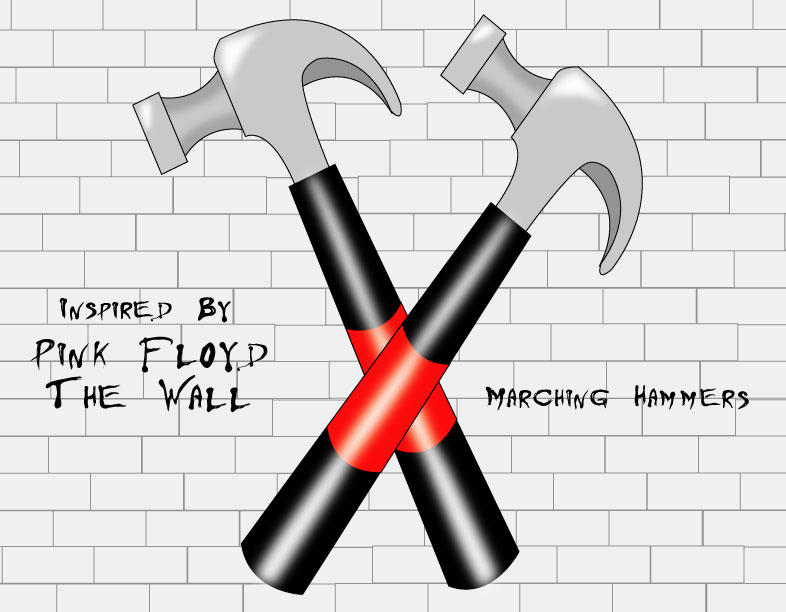
7: Explain the meaning of the double-hammer symbol. Use the scene “In the flesh” to answer.
Hammers are a major symbol which is portrayed all along the movie.
The scene “In the flesh” portrays sort of a political theme where the main character adopts the role of a harsh and claimed dictator. The hammers take on a more militaristic aspect. As I see it, the hammer is a tool that constructs but also destructs, therefore, as the political symbol which represented the society was the “drawing” of two hammers, I can think about the fact how the authorities on one side “construct” the people they wanted to take part of their society, by shaping their thought and expressions and by the other side, they “destruct” the ones who didn’t fit to their plan by repressing them in any way.


8: The children falling into the meat grinder is a visual metaphor that makes a powerful point. What is the metaphor and what point does it make?
One of the most shocking scenes of the movie, is the one where children fall into the meat grinder. The whole disturbing picture can be analyse.
Firstly, the scene portrays how children march through a complex mechanism that creates them on faceless people who eventually lack of their right to be human.  After walking with deliberation the kids  finally fall to a meat grinder. I think the metaphor in the scene is how the educational system or the social sphere pressures the youth and so future generations to think as they planned, and so fit without any problem into a scheme which requires order and rule avoiding individualism, which is a “problem”. This system is represented by the meat grinder which makes people equal and dependent, without special features, just one more of the mass.


9: What is the wall? Can you say whether it is a good thing or not?

The wall in the movie is constructed by the experiences of the protagonist though we can adopt this metaphor for ourselves. We build a wall which is constructed by our life history and the moments we went through, sometimes to separate us from the rest of the world. However in the case of the protagonist of the movie, the wall it’s not a positive thing.  All his struggles are the bricks that constitute the wall, a wall full of unfairness and harsh situations.  The main character isolates himself in his mental and painful wall, each brick further closing him off from the rest of the world.
                           

lunes, 6 de junio de 2016

Notre visite à l'Alliance Française

Resultado de imagen para la alianza francesa buenos airesL’ Alliance Française
Le mardi 17 mai, nous avons visité L´Alliance française. Nous avons partis de l'école à huit heures vers le centre ville, et bien, le voyage a été très long et fatigant, nous étions désireux d'arriver.

Plus tard, nous trouvons un bâtiment élégant et très joli. Nous avons ensuite être divisés en deux groupes d'étudiants sur notre niveau de français (DELF A1 ou A2). Tandis qu'un groupe est allé à la médiathèque, l'autre a vu des vidéos différentes dans une salle, une classe de compréhension de l’orale. Nous avons participé et aussi nous avons parlé française mais timidement. Les deux groupes ont traversé ces expériences amusantes et agréables mais malheureusement ces activités ont duré peu de temps. La visite a été excellente et nous avons appris beaucoup!