Links
https://www.youtube.com/watch?v=BjEFRONjWIo (español)
https://www.youtube.com/watch?v=itsb2SqR-R0 (ingles)
https://www.youtube.com/watch?v=zwibgNGe4aY (ingles, que es el adn)
TRADUCCIÓN
https://www.youtube.com/watch?v=VEy8TYGs4mA&index=5&list=PLRVYj10_Z9sXUa4bQZ3OomSnAc8mJNsAm
TRANSCRIPCIÓN
https://www.youtube.com/watch?v=mf9xLMh2n6w&list=PLRVYj10_Z9sXUa4bQZ3OomSnAc8mJNsAm&index=2
sábado, 4 de junio de 2016

miércoles, 11 de mayo de 2016
CAE writing: Why is it difficult to know the truth about historical events?
Many people contend that knowing with accuracy the cultural past events of a society and the history of a whole community are paths that lead to the truth. While it is true that past issues and situations are a way of understanding the present, it is not that stories about past incidents cannot be changed or exaggerated. Therefore, knowing long time ago events portray several difficulties.
To begin with, one of the main complications towards finding and assuring that facts from the past are trustworthy is the lack of evidence. Nowadays people are satisfied with incomplete background information of facts or convinced with the first and the quickest answers to their inquiry. Looking for valuable responses and adequate descriptions can often be a hard task since it requires time and dedication to be able to picture a historical event.
Likewise, politics is a source of influence towards the masses. Politicians express their ideas and show their points of view after considering the history of the specific town, state or country. However these representatives may interpret past events so as to benefit themselves. Hence, their claims and position towards a past situation can result on deception, outright lies and one sided accounts. For instance, as manipulation can take place, knowing the real details of historical facts is an ardous duty.
As to conclude, I strongly believe that having a general idea about historical stories might be possible but having total knowledge may not unless lot of research from reliable sources is done with perseverance and on a full-scale.
To begin with, one of the main complications towards finding and assuring that facts from the past are trustworthy is the lack of evidence. Nowadays people are satisfied with incomplete background information of facts or convinced with the first and the quickest answers to their inquiry. Looking for valuable responses and adequate descriptions can often be a hard task since it requires time and dedication to be able to picture a historical event.
Likewise, politics is a source of influence towards the masses. Politicians express their ideas and show their points of view after considering the history of the specific town, state or country. However these representatives may interpret past events so as to benefit themselves. Hence, their claims and position towards a past situation can result on deception, outright lies and one sided accounts. For instance, as manipulation can take place, knowing the real details of historical facts is an ardous duty.
As to conclude, I strongly believe that having a general idea about historical stories might be possible but having total knowledge may not unless lot of research from reliable sources is done with perseverance and on a full-scale.
domingo, 8 de mayo de 2016
United States coldest case murder conviction
Maria Ridulph Case
The kidnapping and murder of Maria Ridulph was the oldest cold open case to reach the courts in the history of the United States.
Starting point:
On December 3rd 1957, 7 year old, Maria Ridulph was abducted from Sycamore, Illinois. After dinner Maria was playing in the snow with her friend Kathy Sigman when a young man who called himself “Johnny” approached the girlies and offer them a piggyback ride. A few minutes later, Kathy went to her house to fetch her gloves because is was freezing outside but when she came back Johnny and Maria were nowhere to be seen.
Looking for Maria:
Kathy went to the Ridulph’s house to tell everybody what had happened. Chuck, Maria’s older brother went outside to look for the girly but there was not any signal. Rapidly, the men ran to the house of Ralph and Eileen Tessier (two blocks from the Ridulph). Ralph had a hardware store and the idea was to carry on with the search asking the owner to collaborate with flashlights.
Police investigation:
The following days, the police questioned Eileen Tessier about the events of December 3. John stepsisters heard how his mother told the police something they knew it was not true: that John had been home all night.
In addition, there were conflicting reports about the exact time of the disappearance of Maria. The Sycamore police chief told FBI agents that Kathy and Maria had gone out to play at 18:02, but the county sheriff said Maria had not called Kathy until 18:30. Maria's mother later changed his statement and said the girls could have gone outside even at 17:50.
Kathy Sigman spent hours watching carefully the pictures of people on file by the police, but could not find Johnny.
The local police was sure no one in Sycamore could have done such a thing. It had to be an action done by a trucker or someone passing by. The FBI was not so sure. There were several potential suspects in the village. Police questioned all "known sexual deviants". They investigated a voyeur and followed clues that led up to two men nicknamed "Commando" and "Mr. X”.
Maria’s body is found:
Five months later Maria's body appeared, 190 kilometers from her home. A man found his skeleton under a fallen tree on a farm. The cause of death couldn’t be determined.
John Tessier/ Jack Mccullough
The FBI initially showed interest in Tessier as a suspect, a boy from the neighbourhood nicknamed “Commando”. Three days after Maria disappeared, an anonymous woman warned that a young man named "Teschner" who lived in the neighborhood matched with the description of the suspect. A pair of FBI agents showed up at the Tessier house.
Tessier told them then, and continues stating today, he was in Rockford, Illinois, about 65 kilometers northwest of Sycamore, when they kidnapped Maria. His parents supported his story, and was verified by an irrefutable fact: someone who gave his name made a call from Rockford to the Tessier’s house at 18:57, on 3 December 1957.
There was much discussion about the time of the disappearance of Maria. If the kidnap was done around 19:00, then Tessier had an armored alibi. But if they did around 18:15, then something not locked. John could have gone to Rockford Sycamore car and having arrived at 19:00 before disposing Maria’s body.
No one disputes that John traveled to Chicago for a physical test at the military recruiting center. Tessier said he was walking around Chicago the afternoon of December 3, stood in a cabaret show and then went to Rockford to leave the papers in the recruitment center. Recruiters confirm that they saw by the office between 19:15 and 19:30 that afternoon.
Two days after the FBI interrogated Tessier, he was subjected to the lie detector test. When asked if he had ever had sex with children, Tessier admitted having been involved in "some kind of sex play" with a girl but had occurred several years before. He stated that the episode was over and had no relationship with Maria.
Those details did not raise suspicions at the time. Nor the contradictory versions of his mother when she told the police that his son was home all night and the FBI that was in Rockford that night. Finally, an FBI agent concluded his report by emphasizing: "There will not be other research related to this suspect”
New Investigation:
In January 1994, Eileen Tessier was on the verge of death but she had a secret she didn't want to take to the grave. "Janet!" She called her daughter, according to the statement made to the court itself many years later. Janet ran to her mother's bed. Eileen grabbed her wrist and spoke.
“That girl who disappeared. It was John. You have to tell someone.” Although Janet was a baby when her neighbor of seven years disappeared in 1957, she knew immediately what her mother was confessing, her brother, John kidnapped and killed Maria Ridulph.
It was a decade later when Janet Tessier tried one last time after several denies to tell her testimony. She sent an email to the Police of Illinois: "A seven year old girl named Maria Ridulph disappeared. Her remains were found in early spring of 1958. I think John Tessier, of Sycamore, is responsible for her death. Today he lives around Seattle under the name of Jack McCullough. "
Her urge caught the attention of a boss. He called Janet and she told him how her mother had told her on the deathbed that his brother had kidnapped and killed Maria. "I can not promise anything," said the police chief, "but we will try."
He assigned the case to two men, Larry Kot and Brion Hanley. Kot, 57, was a civilian analyst and worked for the police in Illinois. “I had never heard of the case Ridulph”, but soon he gathered information that cast doubt on the suspect's alibi.
Brian Hanley, 41, made the preliminary work and began by Janet Tessier and her brothers. None had nothing good to say about John, especially Jeanne who was sexually abused at the age of 14 by John.
Crime Chronology:
Tessier said he was in Chicago on Tuesday morning December 3, getting a medical checkup. Kot found that it was true. But he realised that Tessier left the recruitment center at noon. He was later seen in Rockford, almost 150 kilometers from Chicago, about 19:15. But there was no witness to verify his whereabouts between noon and 19:15, which meant he could have easily gone back to Sycamore before appearing in Rockford. Kot examined the account of another witness, the dealer of heating oil. The man knew Kathy Sigman and her family and remembered that the girl had greeted him when he was delivering fuel into a nearby house. He arrived there at 18hrs and was 15 to 20 minutes unloading the oil. When he left, about 18:20, he did not see the girls.
Kot concluded that Maria had been kidnapped before 18:20. If Tessier parked his car in the back entrance, where they found the doll Maria, Rockford could have been addressed directly with the girl in her car. It was a journey of 64 kilometers, and could have come to Rockford in less than an hour.
The call made from Rockford to the house of Tessier, was a key part of John alibi also fit into this new timeline. Phone records showed that the call was made at 18:57 but did not point from which place of Rockford had been realized. Tessier could have called home from a pay phone outside the village.It may be that Tessier's alibi was not as infallible after all.
Arrest:
Hanley took six photos and placed them on the table. Five of them had been removed from Sycamore school yearbook. The photo of John Tessier was a little different. Kathy eliminated several pictures immediately but looked at two: No. 1 and No. 4. He studied for two long minutes. "He is," she finally said, noting the number 4. I had no doubt. Now the detectives had a real suspect. It was time to visit to "Johnny".
Seattle two policemen who had joined the case learned that the "person in question" worked in a block of apartments for elderly people. He called himself Jack McCullough because he had changed the name in the early 90's when he married his fourth wife, Sue, for nearly two decades.
He was a former policeman. The agents examined his file and discovered a lurid past. They learned that he had been dismissed from the police after being accused of abusing a child under 15 years who had run away from home. They also found out about the photo of her 11 year old daughter naked hidden in the bottom of a drawer. Police arrest McCullough on June 29, 2011. Jack McCullough returned to Sycamore handcuffed on July 27, 2011, the same day authorities exhumed the body of Maria Ridulph.
McCullough would face trial for rape before facing trial for the murder of Maria.
Judge Robbin Stuckert raised many doubts after people tell their testimonies which were related to John’s dirty and obscure attitudes. He wondered why the applicant had waited decades to publicize the crime. But the verbal war between Stuckert and Campbell led the judge to withdraw from the murder trial. The case was referred to Judge James C. Hallock.
During the trial, in September 2012, the statement Kathy Sigman on stage was decisive when retold how a stranger who called himself Johnny offered them a piggyback ride, and how Maria and Johnny disappeared when she went home to find her mittens.
Kathy stood firm when she was shown the six pictures of the suspects she had already seen in 2010. Janet Tessier testified about the statement of her mother on her deathbed.
Then three prison informers confirmed that in a conversation with McCullough, he had admitted that he had killed Maria. The trial lasted four days. No McCullough took the stand, so he could not present his alibi. The judge issued the verdict. Guilty on all counts: murder, kidnapping and abduction of a child. And Johnny went to prison.


Jack McCullough, 76, was serving a life sentence for the 1957 murder of 7-year-old Maria Ridulph. Judge William Brady threw out the conviction after a prosecutor found "clear and convincing evidence" that McCullough was wrongly found guilty.
McCullough's lawyers and DeKalb County state's attorney Richard Schmack argued that McCullough's conviction was based on false testimony, improper legal rulings controlling the evidence presented, and a timeline that was tweaked some 50 years after the fact to rule out McCullough's alibi.
McCullough has long insisted that he couldn't possibly have abducted and killed the child because he was 40 miles away in Rockford, Illinois, talking to recruiters and trying to enlist in the U.S. Air Force when she was taken. The prisoner was set free on 2016.
sábado, 30 de abril de 2016
Mitigación: Cuidemos la vida humana y ambiental
¿A que hace referencia el concepto de mitigación ambiental?
Se define el término “mitigación ambiental” como el conjunto de medidas que se pueden tomar para contrarrestar o atenuar el impacto que en mayor parte consiste en una acción antrópica; es decir una intervención causada por el ser humano en el medio que lo rodea. En otras palabras, a través de la mitigación se busca el minimizar eventos desastrosos y peligrosos que atentan contra la vida.
Una vez realizada la lectura del texto que plantea la necesidad de un desarrollo sustentable y estrategias de protección tanto hacia los recursos naturales como a la vida humana, se puede formar una conclusión. Este extracto sostiene el implementar medidas que disminuyan nuestra huella ecológica para asi también reducir los riesgos de vida humana causados por la “respuesta” de la naturaleza, como las catástrofes naturales o “reacciones” desmedidas del medio ambiente.
Por lo tanto, es nuestra responsabilidad, no sólo la de nuestros gobernantes o figuras científicas, si no de la sociedad, el proteger al Planeta Tierra de nuestras propias acciones negativas e inconsideradas. El cambiar nuestra manera de pensar y entonces, nuestra forma de edificar y seguir construyendo en el ecosistema, traerá un beneficio, no sólo para las vidas humanas sino también para el medio ambiente. Una adaptación clave y un ejemplo que implica el cuidado de la vida del ser humano es el evitar construir sobre sistemas vulnerables a inundaciones o desarrollar planes de construcción, de forma que podamos defendernos contra eventos climáticos. Una forma de reducir nuestro impacto en el medio ambiente es el practicar el reciclaje de materiales como el plástico, papel y vidrios. Estos objetos que al fin y al cabo son parte de nuestro consumo traen consecuencias negativas a la naturaleza.
Por ello, la conclusión que logro formular al considerar las ideas y propuestas en el texto es que al reducir la acción (impacto y huella ecologica del hombre), menor será la reacción (eventos desastrosos y de alto riesgo para la vida humana y la biodiversidad implícita en el medio ambiente).

domingo, 24 de abril de 2016
Expertise
How do these items question the credibility of expert sources?
The term "expertise" is frequently used in order to refer to a specialist knowledge and skill in a particular field. Expertise results from training and experience in that field.

Item A: In a way this item shows how expertise fails towards a society. Item A focus on the medicine field and claims their unsuccessful attempts to diagnose and find a cure for a problem the majority faces. The text states how doctors treat the individual and do not focus on the wider community, it shows the effectiveness of doctors to find and change the causes of illnesses, which appear mainly due to bad working conditions or poor hygiene. Therefore the credibility of experts sources is questioned, expertise is seen as harmful.
Item C: In this case, the text portrays how expertise created a misjudgement towards a situation which was not a medical disorder nor a health problem. Long time ago, slaves were associated with having a specific illness called Drapetomania, one that made them want freedom and independence. Item C shows the incorrect judgements experts came up with and it is also linked with changing expertise.
Item D: This item shows how experts in the medicine field misdiagnose, expertise is seen as harmful once more due to the fact professionals associated homosexuality as an terrible illness which needed a cure. Expertise and its credibility are questioned once more because of the misjudgments and prejudice towards a group of people, and the harm homosexuales faced. Moreover this situation was based on changing expertise, nowadays almost the whole population accepts homosexuality so experts tried to fit on the new values.
sábado, 16 de abril de 2016
Nuestra huella ecológica
“El desarrollo sostenible es cuestión de disciplina. Significa que la humanidad debe satisfacer las necesidades presentes sin comprometer las de futuras generaciones”
Gro Harlem Brundtland 1987
Esta frase expresa una postura, en este caso tomada por la ex-primera ministra de Noruega, que tiene como objeto el criticar y replantear las políticas de desarrollo económico globalizador, reconociendo que el actual avance social tiene un costo medioambiental muy alto. El documental “La huella ecológica del hombre” se vincula con las palabras de Brundtland ya que este muestra de manera impactante el consumo del ser humano a lo largo de toda su vida y como cada persona deja su marca en la tierra involucrando a las futuras generaciones.
El análisis del consumo particular de cada individuo es dado a conocer a través de ilustraciones visuales que muestran el impacto que uno genera en la población y en el medio ambiente. De manera interesante y a la vez impresionante el documental aporta datos concretos sobre las cantidad de productos que consumimos y de los cuales seguiremos haciendo uso hasta nuestro últimos días de vida.
Tanto la película como la cita de Brundtland comunican un mismo mensaje concientizador al resto del mundo, el consumismo afecta a la sociedad del presente y del futuro, destruye progresivamente al planeta Tierra, continuamente nos adentramos a la sobreexplotación, al uso irracional y desmedido de los recursos naturales. El mensaje transmitido es un incentivo a reducir la huella ecológica, a pensar y tomar acción considerando toda consecuencia, decidiendo todos los días que consumir en base a previos razonamientos y proyectando a futuro.
Distintas imágenes del documental expresan imponentes y claros informes con respecto a nuestra marca en el medio ambiente. Estos conceptos hacen que el receptor reflexione y advierta la manera en la que consume y tenga una idea general y noción de su propio efecto en la Tierra.


miércoles, 6 de abril de 2016
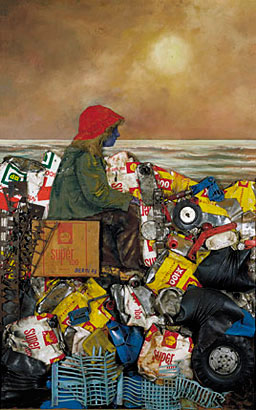
Residuos Narrativos
Antonio Berni fue un pintor, grabador y muralista argentino que creó un personaje artístico llamado, Juanito Laguna, el niño pobre de las grandes urbes latinoamericanas. En él están fundidos muchos chicos y adolescentes en miserables y patéticas circunstancias de vida. Juanito es retratado por Berni con una mirada de denuncia social. Es un símbolo que busca sacudir la conciencia de la gente clamando por justicia.
Berni hizo uso de materiales específicos para llevar a cabo sus obras de arte. Los mismos elementos que rodeaban la vida de aquellos niños pobres, los restos de la sociedad del consumo, los residuos que expresaban testimonios mudos de una terrible realidad.
El consumo y el consumismo tienen como consecuencia un impacto gravísimo que no solo afecta al medio ambiente si no que también a las personas. Las principales victimas son aquellos seres que lamentablemente les tocó nacer y/o vivir en zonas carenciadas, donde los únicos bienes o sustentos que poseen son las sobras del consumo de la sociedad. Juanito Laguna, es una expresión de la realidad, que intenta narrar un mensaje de reflexión al resto de las personas. La creación de este personaje se relaciona directamente con la sociedad consumidora y que se aferra a productos con obsolescencia programada (planificados con un fin a su utilidad), a objetos con valor y uso temporal, a cosas que "satisfacen" las necesidades básicas a medias.


Suscribirse a:
Entradas (Atom)